

Future of Software Management: USU Brings MCP Servers to ITAM and Beyond

AI assistants are getting more capable every month. But they share one problem: They work in isolation. An AI assistant may be brilliant at reasoning and writing, yet it can’t look up your company’s data, start a business process or work with your enterprise software. Not unless someone builds a bridge.
That bridge is the Model Context Protocol (MCP). The connectors that use it are called MCP servers.
This blog addresses the needs of SAM Managers, Heads of IT and Procurement Managers who want faster, more reliable answers from their license data. As a SAM Manager, you’ll spend less time on exports, filters and manual searches. As Head of IT, you’ll get a secure, standards-based way to bring AI into IT Asset Management without building and maintaining custom integrations. And as a Procurement Manager, you’ll go into renewals and vendor negotiations with live figures instead of last quarter’s spreadsheet.
What Is an MCP Server — and Why Does It Matter?
MCP is an open standard that connects AI assistants to the systems where your data lives, from content repositories to business tools. Think of it as a universal plug socket for AI. You don’t need a custom integration for every pairing of AI tool and enterprise application. One open standard is enough, and through it, AI agents find and use what any connected system can do.
Here’s how it works: Developers define a set of “tools,” which are structured actions like “list expiring contracts” or “check compliance status.” The MCP server makes these tools available to any AI client that speaks the protocol. The AI then decides which tools to call, in what order and what to do with the results. You just ask your question in plain language. You don’t need to know anything about the APIs underneath.
In practice, you ask: “Do we have any Microsoft contracts expiring in the next 60 days?” An AI agent backed by an MCP server gets the answer from the live system, formats it and replies in plain language. No dashboard navigation, no Excel export, no manual search. This isn’t a distant vision. It’s exactly what we’re building today.
Imagine you're a SAM Manager at a global enterprise, responsible for managing software contracts and licenses across multiple vendors. Your CIO suddenly asks for a comprehensive status report on your major software vendors — including upcoming renewals, compliance risks and cost-saving opportunities. And you have just one hour to deliver.
Sound familiar? See how the USU ITAM MCP Server turns this time-consuming task into a simple conversation with AI.
We're Building MCP Servers for Our Core ITAM Products
We're developing MCP servers for two of our core products:
SAM for Clients & Datacenter: The MCP Server gives AI agents structured, real-time access to your full Software Asset Management data. That includes software inventory, device records, compliance calculations, contract portfolios, effective licenses and user assignments. The first version reads data across all major data domains. It can also start compliance recalculations whenever you need fresh results.
SAM for SAP Software
SAP license costs are one of the most complex and high-stakes areas of enterprise IT spend. With this MCP server, AI agents answer questions about SAP user types, system measurements and license positions in plain language. Your procurement team gets live data at their fingertips during SAP true-ups and negotiations.
Together, these MCP servers form the foundation of an AI-native layer on top of our product portfolio. You, your partners and our own teams can use it to build smart, data-driven workflows without writing integration code.
What You Can Ask the ITAM MCP Servers: Example Questions
What if you could ask your IT asset management data a question and get an actionable answer in seconds? With the USU ITAM MCP Server, natural-language queries help you explore contract renewals, assess license compliance and identify optimization opportunities — without navigating complex reports or dashboards. Here are examples of questions you or an automated AI agent will be able to ask. The ITAM MCP Servers answer them directly from live data.
SAM for Clients & Datacenter
Contract & License Management
- “Which of our software contracts are expiring in the next 90 days?”
- “Show me all Oracle contracts currently active in Germany.”
- “What are the license terms for our Microsoft Office agreements? Do they include downgrade rights?”
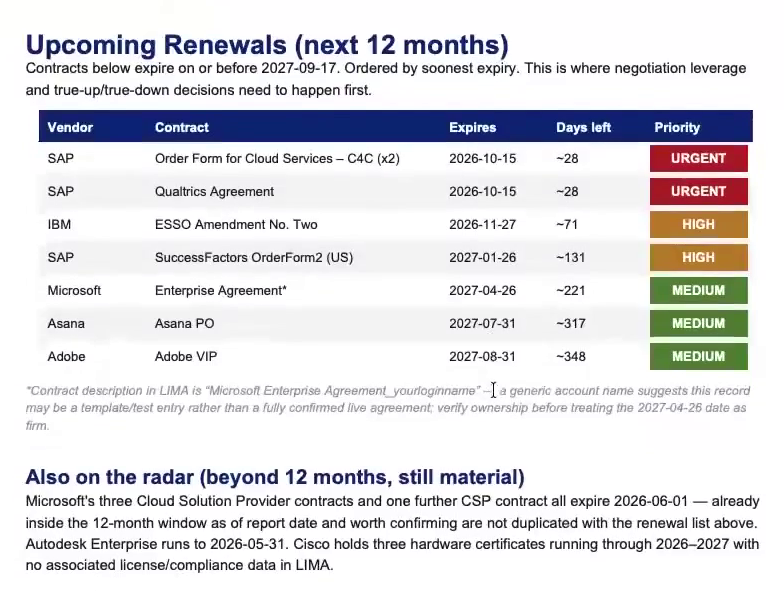 Identify upcoming software renewals, prioritize contracts and avoid last-minute surprises.
Compliance
- “Are our Microsoft licenses compliant across our European operations?”
- “Run a fresh compliance calculation for our SAP parameter set and tell me the result.”
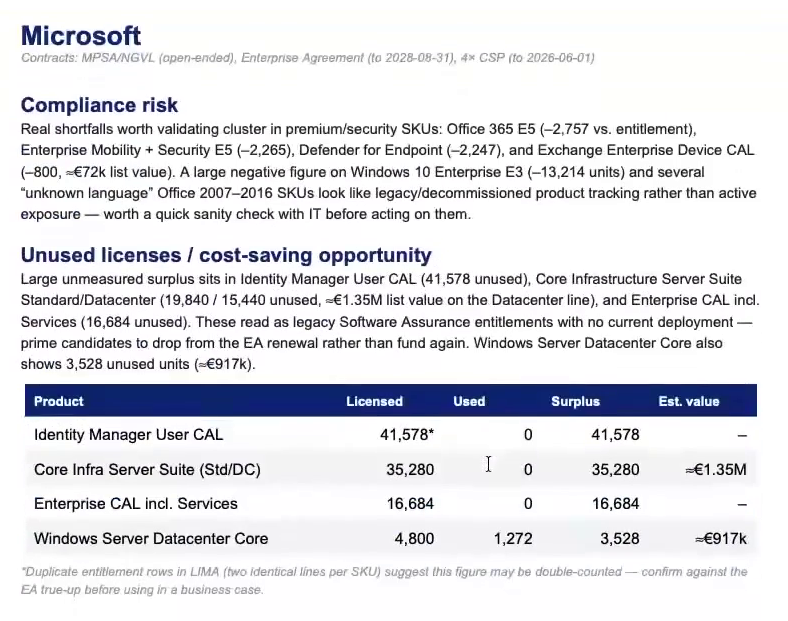 Check Microsoft license compliance, identify potential risks and uncover unused licenses.
Inventory & Asset Visibility
- “How many devices in the Finance cost center are still running Windows 10?”
- “Which software is installed on the devices assigned to cost center IT-WEST?”
Organization
-
“Find all active users in the R&D department who have more than three license assignments.”
SAM for SAP Software
SAP licensing works differently. There’s no simple “installed vs. licensed” count. What a user costs depends on their authorizations, their actual transaction usage, how their accounts across several SAP systems add up to one person and which contract sets the price. USU Software Asset Management for SAP Software already calculates all of this in its simulations. The MCP server turns those results into plain-language answers. The questions below come from real customer scenarios, and all of them are read-only: The agent reads live simulation data and changes nothing in SAP.
Cost Transparency & Internal Chargeback
- “What does our SAP licensing cost each business unit, based on the latest simulation?”
- “Break down SAP license costs by cost center so I can charge them back internally. Also tell me how many users don’t have a cost center.”
- “Which SAP system accounts for the largest share of our license spend?”
License Optimization & Savings
- “Which SAP users haven’t logged on in the last year, and what would we save by reclassifying them?”
- “Show me the users who never logged on at all, and which of them still hold a Professional license.”
- “Which of our SAP accounts are expired or locked but still carry a paid license?”
- “Where are we over-licensed, and which licenses are going unused?
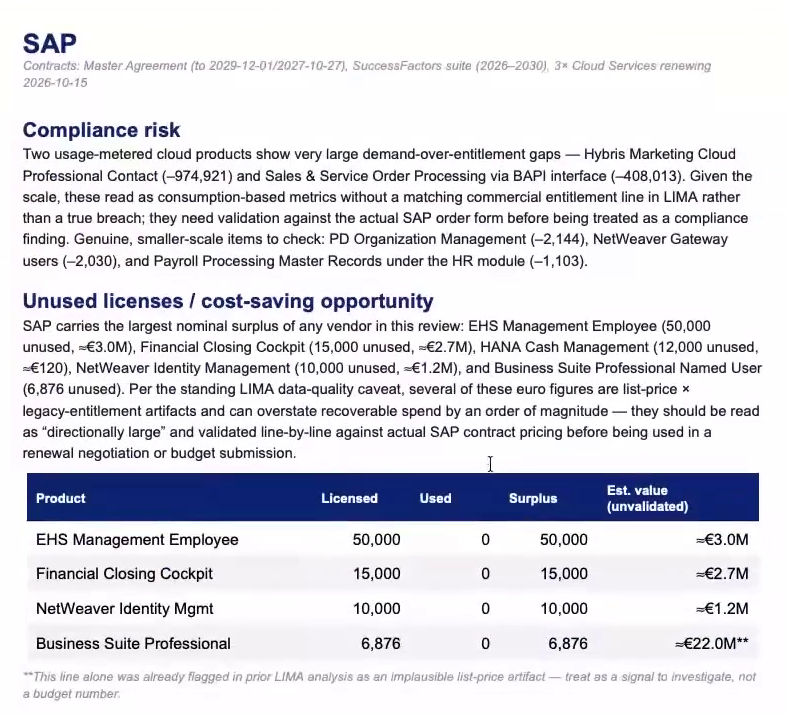
Compare SAP license entitlements with actual usage to identify surplus licenses and potential savings.
Authorizations & Compliance Risk
- “Which users are classified as Professional purely because of authorizations they’ve never used?”
- “For user SMITH01, which authorization objects drive the license classification?”
- “How much would we save by removing assigned but unused authorizations across the landscape?”
Roles & Standardization
- “Which SAP roles drive our most expensive license classifications, and how many users hold each one?”
- “Which role assignments can we remove without changing a single user’s license type?”
- “Show me the top roles per SAP system by cost impact.”
- “Which roles overlap in their authorizations and are candidates for consolidation?”
Contract Scenarios & Negotiation
- “How would our full user equivalent (FUE) requirement and cost change under a different price tier list?”
- “Compare the cost of the current simulation across our available pricing scenarios and tell me which one is cheapest.”
- “What’s the three-year cost of our SAP position at a 15% discount and 20% annual maintenance?”
- “How many licenses of each type have we purchased versus what the simulation says we need?”
Group-Wide View Across the SAP Landscape
- “What’s our total SAP license position across all connected systems, grouped by installation number?”
- “Show me license costs per SAP system group so I can compare our regional entities.”
- “Which SAP systems are connected, and when was each one last measured?”
User Lifecycle Hygiene
- “Show me every SAP account belonging to employee 4711 across all systems.”
- “Which accounts became valid in the last 30 days, and what license type did they receive?”
- “List the accounts that expired more than 90 days ago and are still licensed. These are the orphaned licenses we’re paying for.”
The Bigger Picture
What makes MCP so powerful: It isn’t tied to a single AI assistant or a single product. Because MCP is an open standard, our ITAM MCP Servers work with any compliant AI client. That includes USU agents, your own AI workflows and third-party assistants in Microsoft 365 or your service desk platform.
For you as a USU customer, the effort you’ve put into structuring and maintaining your data in USU Software Asset Management now pays off a second time. The same data becomes directly available to AI, with no re-architecting and no point-to-point integrations.
We believe MCP servers will become as fundamental to enterprise AI as REST APIs are to enterprise software integration today. We’re building this capability now, so you’re ready when AI-native workflows move from pilot to production.
Our ITAM MCP Servers for SAM for Clients & Datacenter and SAM for SAP Software are live and customer-ready. Would you like to hear more about USU’s AI roadmap? Get in touch with your USU account team.


