

How AI Transforms IT Operations Amid Privacy and Compliance Pressures

Artificial Intelligence is no longer a futuristic concept. It’s rapidly reshaping how organizations manage IT operations. Yet despite strong interest and growing adoption, many companies still struggle with unclear regulations, data privacy questions, and governance challenges.
To better understand how IT leaders are approaching AI by the end of 2025, USU commissioned Forrester Consulting to conduct an extensive AI study with 400+ IT decision makers from Europe and North America. The goal: uncover how organizations are adopting AI in IT operations, where they hit roadblocks, and what strategic priorities will define AI maturity in the years ahead.
Below, I summarize the key findings from the Forrester study AI in IT Operations: Balancing Potential With Data Privacy And Compliance and what they mean for IT decision makers evaluating their next steps.
Management Summary
The AI study shows that organizations see artificial intelligence as a foundational capability for staying competitive, even if many are still early in their journey.
AI is needed to stay ahead of the competition
According to the study, organizations believe AI will be critical for driving productivity, innovation, and better decision-making. While many companies are still early in their journey, IT leaders see AI as a foundational capability for staying competitive in the years ahead.
Compliance, privacy, and governance barriers slow progress
Data privacy and regulatory uncertainty are now major operational risks. Many companies admit they lack clarity or internal capabilities to manage AI responsibly at scale.
Leaders must address these challenges quickly
To realize AI’s full potential, organizations must treat governance as a foundation—not an afterthought. Trust, transparency, and compliance readiness are prerequisites for success.
Curious to see how USU can help?
We build our products on an AI platform designed for strong data privacy and governance. You’ll find more details at the end of this blog: How USU Helps
Detailed Findings From the Forrester AI Study
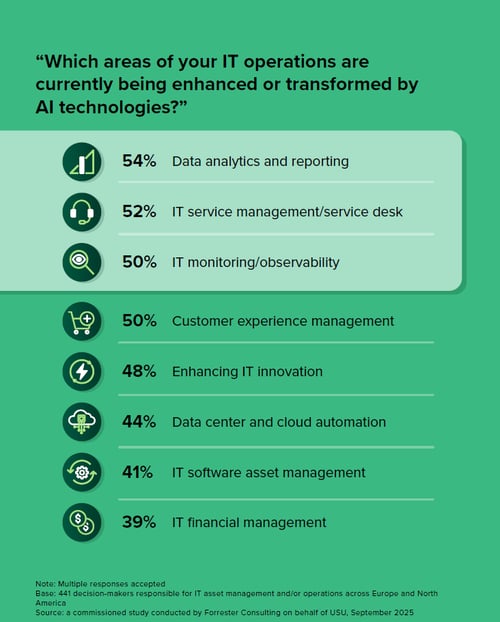
AI in IT Operations: Over 50% of Organizations Already Use It for Core Processes
The study confirms: AI has moved from experimental pilots to real operational impact. Organizations are enhancing data analytics, IT service management, and IT monitoring through AI shifting from reactive operations to proactive, insight-driven teams.
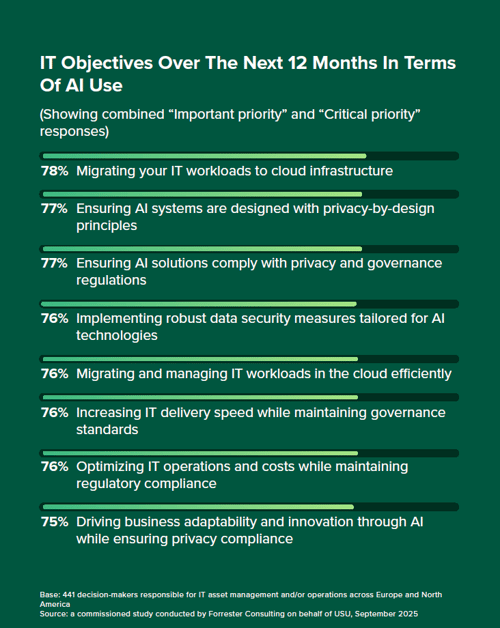
AI Compliance: over 75% Say Regulatory Alignment Is Now Critical
Most organizations see data protection, governance and compliance as a top priority for the next twelve months, influencing how AI projects are planned and executed.
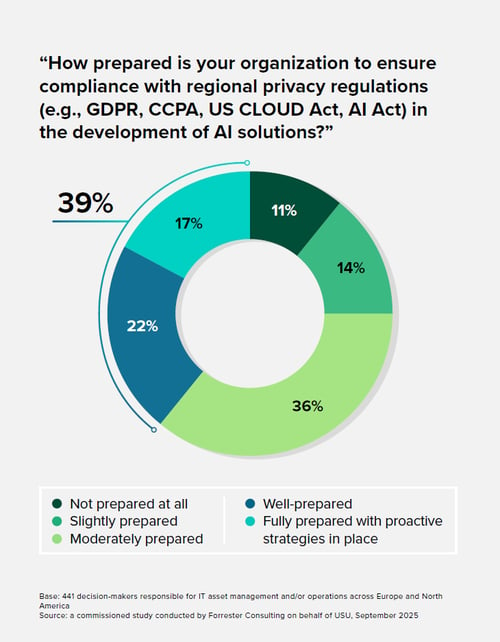
AI Regulatory Readiness: Only 39% Feel Fully Prepared for Regulations
Awareness of the GDPR, CPPA and upcoming AI regulations is high. When it comes to execution, the picture changes: only 39% feel well prepared overall, with slightly higher confidence in Europe and lower levels in the United States.
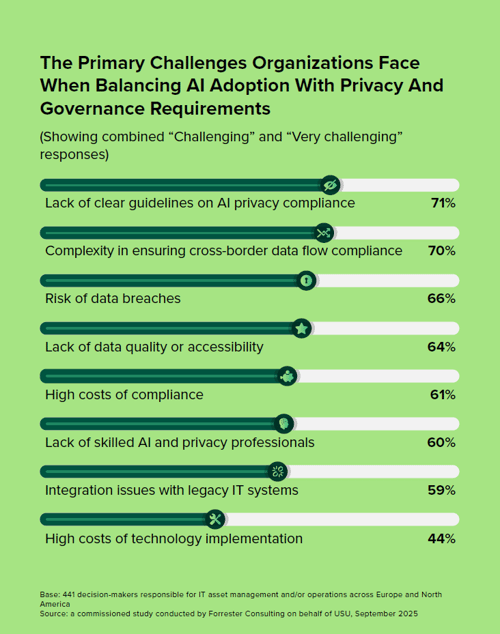
AI Roadblocks: 71% Cite Lack of Privacy Guidance, 70% Face Cross-Border Challenges
The biggest inhibitors to AI scaling are tied to regulation: lack of clear privacy guidelines, cross-border data compliance, and the risk of data breaches. Skill shortages and the rising cost of compliance add complexity.
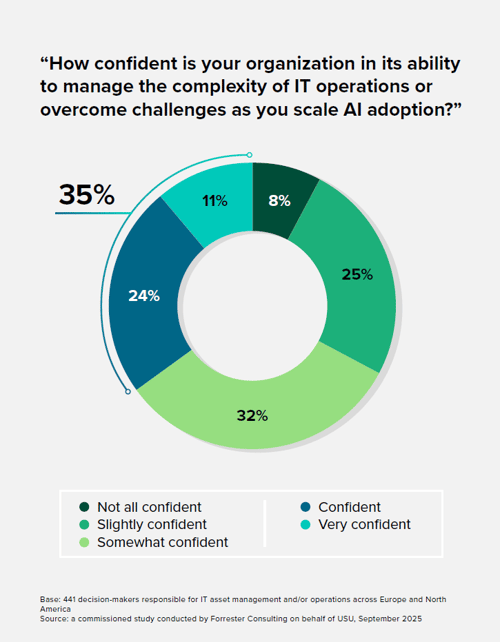
AI Scaling Confidence: Only 35% Believe They Can Successfully Scale AI in IT Ops
Only about one-third of organizations feel confident in their ability to scale AI across IT operations. Legacy systems, fragmented governance, and insufficient AI skills hold back progress.
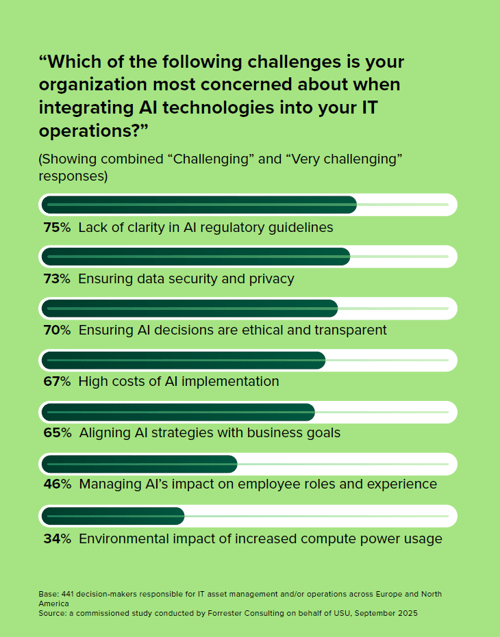
AI Challenges: 75% Struggle With Unclear Regulations
IT leaders must balance speed and responsibility. Transparent governance, ethical AI decision-making, and cost management are now central to AI success and not optional add-ons.
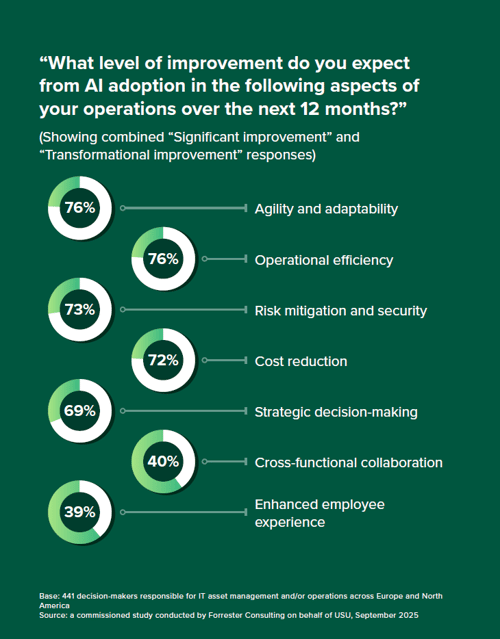
AI Benefits Outlook: 76% Expect Efficiency and Agility
Despite challenges, the expected benefits of AI remain powerful: improved efficiency, better decision-making, increased innovation, and enhanced customer and employee experiences.
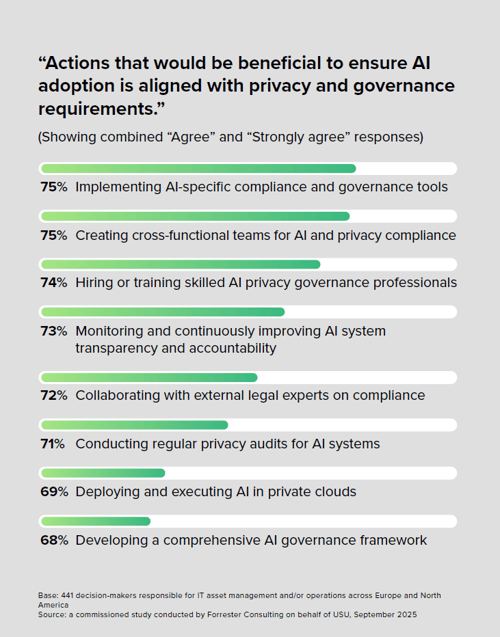
AI Governance Investments: 75% Rely on Cross-Functional Teams and Compliance Tools
Organizations investing in cross-functional governance and AI-specific compliance tooling are better positioned to scale AI responsibly and build trust with stakeholders.

How USU Helps
The findings of the Forrester Consulting AI study make one thing clear: without strong governance and compliant AI foundations, organizations will struggle to scale. This highlights the need for technology that embeds compliance from the start. This is where our USU AI Platform can help.
USU AI Platform: Built for Data Privacy, Security, and Compliance
USU’s AI Platform is built from the ground up with GDPR and emerging AI regulations in mind. You can choose between SaaS or on-premises deployment, allowing you to meet your data privacy, security, and compliance standards without compromise.
--> Learn more about the USU AI Platform.
AI Agents that enable practical, compliant AI adoption
The AI Platform is the foundation for the AI agents integrated into our products. Discover what these agents can do for your organization:
- AI Agents for IT Service Management
- AI Agents for IT Asset Management
- AI Agents for IT Monitoring
- AI Agents for Customer Service Knowledge Management
Together, these tools help organizations turn AI potential into operational value without compromising privacy or compliance.
Download AI Study
Download the full study AI in IT Operations: Balancing potentials with data privacy and compliance from Forrester Consulting for detailed charts and actionable insights.
Top Articles


