
Rowers sailing on big waves
IT Asset Management

RISE with SAP: Tips to streamline SAP Cloud Licensing

Released on
Friday, June 7, 2024
RISE with SAP: Tips to streamline SAP Cloud Licensing
7:22

SAP describes itself as “The Cloud Company” and has greatly expanded its range of cloud-based solutions in just a few years. With the introduction of SAP S/4HANA Cloud Public Edition and, in particular, RISE with SAP, the German software giant has underpinned its cloud-first approach.

Significant Effects for ECC Customers


There is no doubt that RISE with SAP has significant effects for ECC customers that should not be overlooked.

  • ECC maintenance ending by 2027-2030
  • Halted ECC innovations
  • Annual 5% maintenance fee hikes

If you're contemplating migrating to SAP Cloud using the RISE program, it's imperative to meticulously assess various factors to optimize benefits. If you are an existing ECC customer considering a migration to SAP Cloud using the RISE program, you should carefully consider a number of factors beforehand in order to get the best possible value.

What is RISE with SAP?

RISE with SAP aims to simplify cloud migration for customers and provide personalized support throughout the journey to becoming an "intelligent" enterprise. It's more than just moving to SAP S/4HANA: It's about enabling continuous digital transformation with cloud-focused solutions, services and tools.

Initially, the offering included five core elements: SAP S/4HANA Cloud, Business Process Intelligence (BPI), SAP Business Technology Platform (SAP BTP), access to the SAP Business Network and various integrated tools and services. RISE with SAP operates on a subscription basis with a service level agreement (SLA), bundling components into a single package at a fixed price. SAP manages solution operation and troubleshooting.

Infrastructure hosting options include SAP or hyperscalers like Google Cloud, Amazon Web Services or Microsoft Azure. According to SAP, RISE with SAP can cut total cost of ownership by up to 20% compared to on-premises SAP S/4HANA implementation, inclusive of migration expenses.

RISE with SAP, SAP S/4HANA Cloud; Where’s the difference?

RISE with SAP is closely tied to SAP's strategic pivot toward cloud computing, specifically the SAP S/4HANA Cloud. It's tailored to aid companies in transitioning to the cloud with a plethora of innovations and solutions. The SAP S/4HANA Cloud, available as both public and private cloud options, stands as a cornerstone of RISE with SAP.

While RISE with SAP offers a comprehensive cloud solution, it's important to note that it's not mandatory for utilizing SAP's cloud offerings. Companies can access solutions like SAP S/4HANA Cloud, Public Edition, and SAP S/4HANA Cloud, Private Edition independently, "without RISE."

Furthermore, since the start of 2023, the GROW with SAP commercial package has been available, particularly catering to new customers in the midmarket segment. Through GROW, organizations can opt for SAP S/4HANA Cloud Public Edition, where the cloud ERP's infrastructure and software capabilities are shared among SAP customers and managed directly by SAP.

The FUE Model - Opportunity or Cost Trap?

Can you remember the current use type scenario with SAP S/4HANA on-prem? SAP distinguishes six application scenarios: Developer Use, Professional Use, Functional Use and Productivity Use (as the most important Use Types), Engine Use and Technical Use.
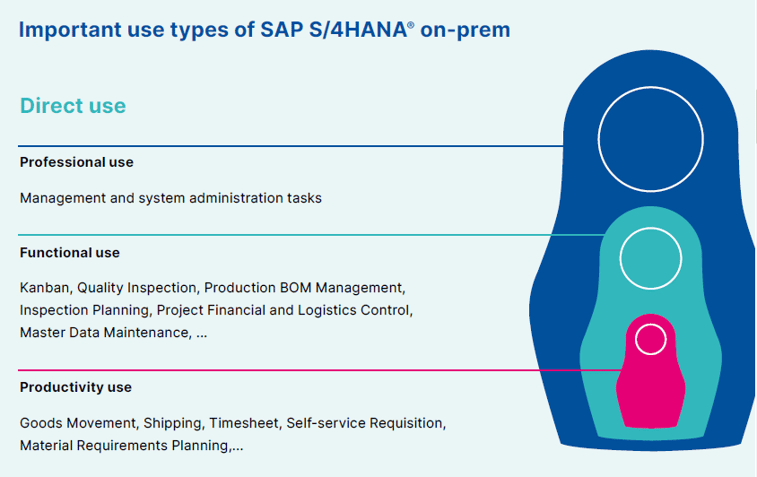


SAP Use Types EN

Copyright: USU Software AG

The new "Full USe Equivalent" (FUE) model at RISE with SAP is different. With RISE with SAP S/4 HANA Cloud, SAP has taken a step towards user licensing making license management easier. Instead of purchasing exact numbers of specific user license types, SAP customers can purchase so-called FUEs, Full Use Equivalents.

FUE is a fictive number that corresponds to the theoretical number of individuals authorized to access the full solution capabilities. Individuals with less authorizations are taken into account by calculating the corresponding FUE by using a conversion factor. It’s defined as follows:

1 FUE =

  • 1 SAP S/4HANA for Advanced Use
  • 5 SAP S/4HANA for Core Use
  • 30 SAP S/4HANA for Self-service Use


The FUE model is a flexible way to use user licenses for different use types. With a RISE with SAP contract, there is no need to specify the relationship between the different use types. It offers great flexibility: Savings can be achieved without reconfiguration right or contract renegotiation. FUE is available with different tiers, such as:

1001-2000 Users: USD 178 / FUE / Month (Private Edition) or USD 147 / FUE / Month (Public Edition).

However, a solid analysis of the previous named user licenses is needed so as not to generate unnecessary costs. Implementing pricing without contextual analysis of assigned license types can drastically affect the final amount of FUEs purchased. USU’s SAP-certified SAP software optimization tool can show calculated FUE values on a dedicated results page.


Below is a customer sample for an environment of 1,000 users before and after license optimization.


License

Number of licenses without opt.

Number of licenses after optimization

Weight

FUE without optimization

FUE after optimization

Developer Access

10

10

0,5

20

20

Advanced Use

355

154

1

355

154

Core Use

545

345

5

109

69

Self Service

90

491

30

3

17

Sum

1000

1000


487

260


As you can see, the customer realized savings of 227 FUE while maintaining the number of users.  

In our above example of 1,000 licenses the achieved savings were USD 33,310 per month (Public Edition).


SAP user licenses are a significant component of the costs associated with S/4HANA. Before migrating to S/4HANA, it is a good idea to carefully review your current licenses to make sure they are optimized for actual system usage.


Conclusion

Managing SAP licenses is a major challenge for many customers, whether in the traditional on-premises world or in dynamic cloud environments. Standard contracts from RISE with SAP include licensing based on authorization instead of usage.

This has an impact on the price: authorization-based licensing is on average 50 - 150% more expensive than usage-based licensing. This significant price increase is just one example of some of the pitfalls that customers will have to watch out for in the future.

As an SAP customer, you still have a lot of influence over the conditions and scope of the SAP products you want. It is crucial that you understand and actively manage the SAP offering. This enables you to find the best options for you that really meet your ERP requirements and budget.

With our SAP-certified SAP software optimization tool and expert in-house team, we can help you optimize your ECC licenses and customize your ideal S/4HANA system or FUE licenses based on actual usage and entitlements.

Our advice to SAP customers: Don't leave the wheel to your software provider, stay in control.

 

usu_sam_eb_rise-with-sap_en_cover_800x800px
E-Book

RISE with SAP®: Effective Licensing in the Cloud

Navigate the dynamic world of SAP Cloud offerings: Learn how to streamline SAP Cloud contracts with tools and reduce license costs.

Frequently Asked Questions

Is RISE with SAP simply a migration from on-premises ERP to the cloud?

No. RISE with SAP should be viewed as a broader transformation framework rather than a simple infrastructure migration.

For organizations running SAP ECC or older ERP environments, the move can involve application modernization, business-process redesign, integration changes, data transformation, security controls, and changes to how the ERP environment is operated. The appropriate transition path depends heavily on the starting environment and the organization's transformation objectives.

For example, SAP identifies different approaches for existing S/4HANA environments, ECC systems, and third-party ERP platforms, ranging from system conversion and selective data transition to new implementation. The choice should therefore be based on business and technical requirements rather than treating every migration as a lift-and-shift project.

How should companies decide between SAP Cloud ERP Public Edition and Private Edition?

The decision largely depends on the degree of standardization, process differentiation, customization, and control an organization requires.

Public Edition is generally suited to organizations willing to adopt standardized cloud processes and operate within a more prescriptive SaaS model. Private Edition provides greater continuity for organizations with complex processes, existing SAP investments, or requirements that make a more controlled transition appropriate.

The decision should consider factors such as:

  • Complexity of existing business processes
  • Extent of custom development
  • Regulatory and data requirements
  • Integration landscape
  • Geographic operating model
  • Need for differentiated processes
  • Desired pace of standardization

Organizations should evaluate the target operating model before selecting the deployment model, rather than selecting the cloud edition solely on infrastructure considerations.

What does "clean core" mean in a RISE with SAP transformation?

A clean core means keeping the central ERP platform as close as practical to the standard SAP software while moving differentiated functionality into appropriate extension mechanisms.

This matters because extensive modifications to the ERP core can make upgrades, testing, integrations, and future innovation more complicated. SAP's current modernization guidance emphasizes moving toward a clean-core cloud foundation, while industry research also identifies clean core as an important strategic consideration for SAP ERP leaders.

A clean-core strategy does not mean eliminating every customization. Instead, organizations should determine which custom developments are genuinely business-critical, which can be replaced by standard functionality, and which should be redesigned as extensions.

What happens to existing SAP customizations during the migration?

Existing customizations should be assessed individually rather than automatically carried into the target environment.

A typical assessment categorizes custom developments into several groups:

  1. Retain – functionality remains necessary and has a valid role in the target architecture.
  2. Replace – standard SAP functionality can meet the requirement.
  3. Redesign – the business requirement remains, but the technical implementation should change.
  4. Retire – the customization no longer provides sufficient business value.

This assessment is particularly important for heavily customized ECC environments. SAP now provides tooling intended to analyze custom ABAP developments and determine how they should be handled during modernization.

The objective should be to preserve valuable business capabilities without unnecessarily reproducing technical debt.

How does RISE with SAP affect enterprise integration?

Moving the ERP platform to the cloud does not eliminate the need for integration architecture. In many cases, it makes integration governance more important.

Organizations should inventory interfaces connecting ERP with systems such as:

  • CRM and customer platforms
  • Manufacturing and shop-floor systems
  • Warehouse management
  • Banking and payment platforms
  • E-commerce systems
  • HR applications
  • Tax and regulatory services
  • Data warehouses and analytics platforms
  • External suppliers and business networks

The migration is therefore an opportunity to rationalize integrations, retire obsolete interfaces, establish consistent API and event-driven patterns, and reduce point-to-point dependencies.

A successful RISE program should produce an explicit target integration architecture, not simply reproduce the existing interface landscape in a new hosting environment.

Does moving to RISE with SAP reduce the responsibility of the internal IT organization?

It changes the responsibility rather than eliminating it.

Cloud services can shift portions of infrastructure management and technical operations away from the customer. However, the customer remains responsible for areas such as business-process ownership, data governance, identity and access management, integration decisions, testing, compliance requirements, and organizational adoption.

This creates a potential shift in the IT operating model: fewer resources may be required for traditional infrastructure administration, while greater emphasis may be placed on enterprise architecture, data, security, integration, vendor management, and business transformation.

Organizations should therefore define their post-migration operating model before going live.

What should companies consider regarding cybersecurity and compliance?

Cloud ERP security should be evaluated as a shared-responsibility model.

Organizations need to establish which security controls are provided by SAP and which remain customer responsibilities. Areas requiring particular attention include:

  • Identity and access management
  • Privileged access
  • Segregation of duties
  • Interface authentication
  • Data classification
  • Encryption requirements
  • Logging and monitoring
  • Regulatory retention requirements
  • Third-party integrations
  • Business continuity and disaster recovery
  • Security testing and incident response

Moving ERP workloads to the cloud can change the control environment, but it does not remove governance obligations. Security and compliance requirements should therefore be incorporated into the migration architecture rather than addressed after implementation.

How important is data quality when moving to RISE with SAP?

Data quality is one of the most significant determinants of migration complexity.

Organizations should not treat migration as a technical exercise of transferring every available record into the target environment. Instead, data should be assessed according to business value, legal requirements, operational requirements, reporting needs, and retention policies.

Key activities typically include:

  • Master-data cleansing
  • Duplicate identification
  • Data ownership definition
  • Historical-data assessment
  • Archiving strategy
  • Data mapping
  • Reconciliation
  • Validation of migrated balances and transactions

The target system should contain the data required to operate and govern the business—not simply a copy of everything accumulated in the legacy environment.