What is IT Asset Management?

IT Asset Management is the discipline that tracks, governs and optimizes all IT assets across their entire lifecycle.
pillar-page-itam-what-is-it-asset-management

Introduction

IT assets are the foundation for digital-first companies. They are no longer just support tools; they are the backbone of modern business operations and competitiveness. Effective management transforms technology from a costly overhead into a strategic advantage, improving productivity, reducing risks, and boosting the bottom line. 

Depending on the size of the company, average annual IT expenditure per employee ranges between €1,200 and €3,000. For a company with 5,000 employees, this quickly adds up to $10 million or more per year.

Every IT department faces a similar challenge when planning and procuring IT assets. IT assets must be tracked and maintained throughout their life cycle. To stay organized and optimize IT spending decisions, there is a plethora of information that must be recorded and monitored. Everything from date of purchase and relevant contracts to IT asset owner(s) and device servicing must be recorded, and the information made accessible to those who need it. But what is IT Asset Management (ITAM) and how can a company maximize their IT Asset Management value?

In this article, we’ll provide a zipped guide on what IT Asset Management is, why it’s important and how you can optimize your company’s IT assets with USU’s versatile ITAM software solution.

What is IT Asset Management?

IT Asset Management is the process of planning, procuring and maintaining all types of technology assets, including physical and virtual assets, throughout their lifecycle. IT asset management is not a one-time project, it is an ongoing process that serves to organize IT asset inventory, optimize asset usage and costs. ITAM provides the documentation and data needed to make informed financial decisions.

ITAM is closely related to IT Service Management (ITSM). However, ITAM and ITSM each focus on a different area of IT management. ITAM primarily involves managing the financial and compliance aspects of an asset, including total cost, ownership, contracts and warranty information.

ITSM, on the other hand, manages the operational and support aspect of an IT asset. IT Asset Management and IT Service Management work hand-in-hand, therefore it’s important for a company to choose an ITAM solution that is compatible with the company’s ITSM solution.

IT Asset Management is a process that can be systematically executed. To ultimately achieve the company’s objectives, it’s important to have a thorough understanding of the different stages of an asset’s life cycle and maintain asset records. The life cycle can be divided into five principle stages: planning, procurement, deployment, maintenance and decommission/removal.

IT Asset Management also involves phases of critical financial planning, benefit analysis and deployment analysis. Purchasing and deploying an asset requires thorough documentation, maintenance of records, contracts and vendor relationships.

Why companies need ITAM

IT Asset Management is more than just a process. Rather, it is a set of procedures to improve a company’s technology asset management system and reduce or eliminate overspending.

Analyst firm Gartner projects global IT spending will reach $5.43 trillion in 2026, with software and cloud services driving much of that growth. This brings opportunity—but also
complexity.

According to IT management studies, organizations waste an average of 25% to 30% of their software-as-a-service (SaaS) and software license budgets annually. This "toxic spend" is primarily attributed to unused licenses, redundant applications, and underutilized premium features. 

You may already have several tools managing IT assets. But without a unified approach, growth becomes uncontrolled spend, audit exposure and wasted budgets. That’s where IT Asset Management (ITAM) comes in.

The business value of an ITAM system is largely dependent on a company’s record-keeping and reporting capabilities.

Some proven benefits of modern ITAM include:

  • Automated Discovery: Real-time inventory updates without manual intervention
  • Ensure license compliance by balancing purchased entitlements with actual usage
  • Extended compliance: Cloud-based subscriptions, which requires tracking user-based access rather than just installations
  • Increased efficiency: Better spending decisions based on data-driven insights
  • Detection of Shadow IT: From uncontrolled license purchasing and usage
  • Management of IT costs and asset usage in nearly real-time
  • Unified Repository: A single dashboard to track all IT and non-IT assets
  • Proactive Health Monitoring: Alerts for low disk space, high CPU usage, or expiring warranties
  • Integration with ITSM: Seamless connections with IT Service Management platforms like ServiceNow for automated workflow
  • IT-Governance: Alignment of IT resource spending with business goals


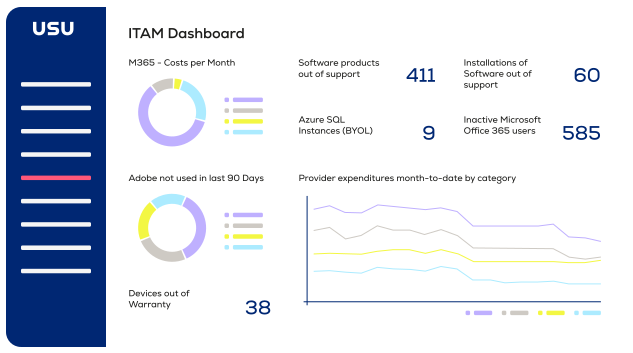
With an IT Asset Management system in place, customers can control their IT asset inventory with automated tracking and reporting tools. Furthermore, an organized IT asset register makes risk management easier, helps streamline IT operations and reduces overspending on IT assets. ITAM reporting capabilities also improve visibility, enhance productivity and provide the information needed to achieve the IT department’s objectives.

Would you like to learn more about how we help our customers to discover and manage all IT assets, ensure license compliance or help to reduce their software spend? 


USU ITAM Case Studies

usu-it-asset-management_axel-springer_1000x1000px

Axel Springer streamlines costs with intelligent ITAM

6-digit SaaS spend savings for large vendors

usu-it-asset-management_metro_1000x1000px

Centralized ITAM solution minimizes manual effort and software costs

METRO introduces group-wide IT asset management

What are IT assets?

Every IT department has an asset inventory that requires consistent maintenance. This inventory consists of both physical devices such as computers and other tangible devices and virtual assets such as software licenses, contracts and software applications. These include both tangible and intangible assets. 

Types of assets

Tangible/Physical Assets:

  • Laptops and computers
  • Mice
  • Keyboards
  • Printers
  • Monitors
  • Servers
  • Drives

 Intangible/Virtual Assets:

  • Software
  • Software licenses
  • Cloud licenses
  • Contracts

Categories

IT Asset Management can be separated into multiple categories with subcategories and managed individually according to their attributes and purposes:

Hardware Asset Management:

  • Hardware Asset Management tracks and maintains physical IT assets, such as laptops, servers, workstations, endpoint devices, etc.
  • Fixed Asset Management tracks and maintains physical assets used within an IT office, such as network cabinets, cables, desks, server room equipment (such as AC units), etc.
Software Asset Management:


Software Asset Management encompasses the management of all software assets, including licenses and applications used within the IT infrastructure.

Cloud Asset Management:

With the shift to remote work and cloud-first strategies, this category tracks virtualized resources. It manages:

  • Software as a Service (SaaS): Monitoring subscriptions and usage.
  • Infrastructure as a Service (IaaS): Tracking virtual machines and storage.
  • Platform as a Service (PaaS): Monitoring cloud platforms used for development.

Digital Asset Management (DAM):

Digital Asset Management tracks and maintains all digital content or files owned by an organization. Some examples of digital assets include: documents, images, video files, metadata, presentations, etc. Digital assets are intangible, right-to-use assets.

Enterprise Asset Management (EAM):

Enterprise Asset Management helps you manage assets that keep your business running, even when they sit outside your traditional IT landscape. It includes IoT devices and other non-IT assets connected to your network, bringing everything together as one technology ecosystem.

Components of IT asset life cycle management

IT assets have a kind of life cycle. This life cycle is comprised of five key stages:
 

1. Planning

The planning stage is a strategic phase involving important financial planning, benefit analysis, procurement and deployment phases and finally decision-making about asset purchases.

2. Procurement

Asset procurement may involve purchasing the asset, signing a licensing agreement or even building the asset. This stage also involves the process of cataloging all asset information into an asset register or ITAM software platform.

3. Deployment

Deployment involves the configuration, implementation and assignment of asset ownership and permission rights.

4. Maintenance

The maintenance phase involves tracking asset ownership, recording device servicings, ensuring licensing compliance, monitoring license renewals and software upgrades.

5. Decommission

The decommission stage of the asset lifecycle is also known as the retirement or removal phase. Assets that are, for example, outdated, broken or dysfunctional must be removed and usually require a replacement.

What is the difference between ITAM, SAM, HAM and CMDB?

Here’s a simple way to understand the difference between ITAM, SAM, HAM and CMDB—and how they work together.

IT Asset Management (ITAM):

ITAM is the big picture. It helps you track, manage and optimize all your IT assets across their entire life cycle—from purchase to retirement. This includes hardware, software and related contracts and costs. ITAM gives you financial control and transparency.


Software Asset Management (SAM):

SAM is a specialized part of ITAM that focuses only on software. It helps you manage licenses, stay compliant with vendor agreements and avoid over- or under-licensing. With SAM, you reduce risk and cut unnecessary software spend.


Hardware Asset Management (HAM):

HAM is another subset of ITAM, focused on physical devices. It tracks assets like laptops, servers and network equipment, including ownership, location, lifecycle status and maintenance. HAM helps you control costs, plan refresh cycles and reduce asset loss.


Configuration Management Database (CMDB):

The CMDB is a central data source, not a management practice. It stores detailed information about configuration items—such as devices, software, services and their relationships. ITAM, SAM and HAM all use CMDB data to understand how assets connect to each other and support your services.

In short:

  • ITAM manages all IT assets

  • SAM manages software licenses and usage

  • HAM manages physical hardware

  • CMDB stores the data and relationships that support all of them

Together, they give you a complete, reliable view of your IT environment so you can make better decisions.

As a recognized leader in IT Service Management and IT Asset Management, USU combines deep product expertise with integration and services. Learn more about how we help our customers to integrate multiple source to create "Golden Records" as an integral part of IT processes.

What is ITAM software?

ITAM software are tools designed to improve the process of tracking and maintaining an IT asset throughout its life cycle, as well as optimizing usage and reducing spending.

The business value of an ITAM system can be gained largely from a company’s record-keeping and reporting capabilities. A company’s IT Asset Management value can be realized by utilizing the information collected from ITAM software to optimize current IT assets and strategically plan and execute future asset procurement and deployment.

Having an efficient IT Asset Management platform where all asset information is centralized and accessible to relevant individuals is a key component to driving success within the IT infrastructure and maintaining a budget. By optimizing the IT asset data management process, companies can more effectively record and monitor both physical and virtual IT assets, forecast IT spending, run internal IT asset audits and consequently reduce overall IT spending.

An ITAM software solution should include several basic functions to keep your IT assets organized, maintain compliance and optimize security. Some of these functions include spending reports, license usage reports, asset ownership tracking, inventory tracking, configuration management tools, auditing capabilities and more.

How do ITAM processes work?

IT Asset Management is a process to track and monitor ITAM inventory, including tracking ownership of each IT asset, where it’s located, any services an asset has received and relevant contracts or warranties related to the asset.

The IT Asset Management process is based on the ‘Four Dimensions Model’ defined by ITIL (IT Infrastructure Library - a set of industry standard IT principles and best practices):

  • Organizations & People: The first dimension outlines the need for allocating roles and responsibilities within an organization. For ITAM, this includes assigning certain asset management responsibilities, such as asset register maintenance or IT asset compliance, to certain asset managers.
  • Information & Technology: The second dimension refers to the reliance on technology solutions to optimize workflows and expense management. Manual record keeping is no longer as reliable or expedient as software and hardware asset management tools that can automate these processes and improve visibility with real-time reporting.
  • Partners & Suppliers: The third dimension defines the relationship between an organization’s IT department and third-party vendors or suppliers. Most virtual IT assets, such as software application licenses and cloud licenses, are provided through third-party vendors and suppliers. This dimension provides a set of guidelines to record all details including purchase date, contracts, warranties, renewal dates, etc.
  • Value Streams & Processes: The fourth dimension touches on the relationship between ITAM processes and IT Service Management (ITSM) as a whole. This includes the collaboration between the IT Asset Management and IT Service Management teams to improve IT services across the department.

IT Asset Management also requires the establishment of ITAM policies. ITAM policies are guidelines that help ensure the proper documentation and handling of IT assets. Some of the purposes of IT Asset Management policies coincide directly with each stage of the asset life cycle.

Important elements of an ITAM policy include the governance of:

  • Software catalogues
  • IT asset purchasing
  • IT asset deployment
  • Maintenance & upgrades
  • Functionality monitoring
  • IT financial management
  • Asset ownership
  • Asset removal
  • Record keeping

A clearly defined ITAM policy provides more than just a set of spending and usage guidelines, it can also help improve the optimization of IT asset spending, utilization, risk management, compliance, strategic decision-making and vendor information management.

Components of modern ITAM

The future of ITAM is closely tied to AI, automation and cost optimization strategies. Advanced ITAM solutions can automate inventory management, forecast IT spending and optimize asset usage, enabling organizations to make faster and more informed decisions.

Integration with FinOps is becoming increasingly important. By linking ITAM with financial operations, companies can manage IT costs more effectively, track spending across the asset lifecycle and improve budget planning.

Modern ITAM must also support global and hybrid IT environments, providing scalable solutions for complex, distributed infrastructure. This includes managing on-premises systems alongside cloud and SaaS assets seamlessly.

Looking at the evolution of ITAM, the discipline has grown from manual spreadsheets and isolated tracking to AI-driven life cycle management platforms. This progression not only streamlines operational processes but also positions ITAM as a strategic tool for optimizing resources, costs and compliance.

Where to start an ITAM project?

Every company’s ITAM priorities look different. But across industries, there are four typical use cases that will consistently deliver value. Customers must define the use cases that matter most.

1. IT asset visibility

You can’t manage what you can’t see. Without full visibility, companies waste approximately 25% of software spend. Your ITAM solution should give you a single, centralized view of:

  • SaaS subscriptions and user access
  • Hybrid environments and cloud consumption
  • On-prem installations and usage
  • Virtual machines and containers

Look for agent and agentless discovery options, support for custom scripts and APIs, and the ability to pull from systems like SCCM, ServiceNow and Azure.

2. License compliance

Audit risks are real—and expensive. The average audit costs $1–5M in true-ups. ITAM eliminates that risk. An effective ITAM solution:

  • Tracks entitlements and usage by product and vendor
  • Calculates product use rights (PUR) and complex metrics
  • Detects shadow IT and unapproved installs
  • Shows compliance risk by region, business unit or role

Integrated dashboards should make these insights clear and actionable.

3. Cost Optimization

The fastest wins in ITAM come from cutting waste:

  • Reharvest unused software licenses to cut costs by 30% in year one
  • Plan renewals based on real consumption, not assumptions
  • Analyze BYOL vs. subscription in cloud environments

Metering tools and SSO logs can help identify low-usage software and trigger license reclamation workflows.

4. Enhanced Security

A strong ITAM platform protects you from more than audits. Think of shadow IT which isn’t just compliance risk—it’s a breach waiting to happen. An ITAM solution can help you:

  • Limit access by role, region or system
  • Track activity logs via SSO and authentication data
  • Support GDPR and data protection requirements
  • Find shadow IT using expense reports and AD logs 

Security teams are often overlooked in ITAM planning. Bring them in early—they’ll help align license tracking with broader IT governance.

How USU approaches ITAM

USU’s IT Asset Management software is designed to help organizations gain a comprehensive view of their IT assets, reduce costs, maintain compliance, and minimize risk. It provides visibility across hardware, SaaS, cloud and on‑premises resources, using both agent‑based and remote discovery technologies to ensure accurate asset data.

A key part of USU’s approach is centralized asset inventory and reporting, which consolidates hardware, software, supplier and contract information in one platform. This makes it easier for IT teams to understand usage, forecast costs and prepare for audits.

USU also integrates software asset management capabilities, including license optimization, compliance insights, and SaaS discovery, helping companies track and manage software spend more effectively.

Additionally, USU offers IT Asset Portfolio Management tools that automate portfolio analysis, enrich product data with vulnerability and end‑of‑life information, and generate customizable reports to support strategic decision‑making.

Many of USU’s capabilities are supported by AI‑driven functionality, which enhances data quality, accelerates discovery processes and supports informed IT investment planning.

Conclusion

IT Asset Management is an indispensable IT function. With the right technology solution, your company can better maintain IT asset information, track an asset’s life cycle and optimize IT spending. Certain areas of business are common troublemakers when it comes to overspending. One of those areas is the IT department. Without a strong and organized management system in place, overspending on IT assets such as software subscriptions and cloud licenses will frequently go unnoticed and develop into the bleeding heart of an IT department’s budget.

With an ITAM solution, such as USU’s IT Asset Management software, you can make your life a little easier and structure your IT Asset Management workflow with a multifaceted and customizable solution. Integrating our IT Asset Management software into your IT workflow is like a breath of fresh air. Our software delivers a variety of features and functions that can be uniquely configured to meet your business needs and effectively monitor, track, report and audit all of your IT assets.

Are you interested in knowing more about our IT Asset Management solution? Contact us for a non-binding discussion.


Frequently asked questions

What is the meaning of ITAM?

ITAM is an acronym for IT Asset Management. IT Asset Management is a system of planning, procuring, cataloging and maintaining both tangible and intangible IT assets. ITAM utilizes software solutions and tools to automate this process and organize collected information into a single repository.


By implementing an IT Asset Management process, companies can optimize their IT asset usage and spending by improving visibility, optimizing asset usage, such as cloud license usage, and eliminating overspending on unnecessary assets.

What is ITAM responsible for?

IT Asset Management is responsible for recording asset inventory, contracts and warranties, assigning permission rights and asset ownership, as well as maintaining compliance, security and optimizing usage. 

As a company scales up, tracking all the details surrounding their IT assets can become incredibly complex and disorganized, leading to unmonitored usage and spending. ITAM organizes asset information and automates record keeping and maintenance procedures with dedicated ITAM tools and services.

What are ITAM best practices?

IT Asset Management processes vary between organizations based on specific business needs; however, there are some fundamental best practices that every ITAM workflow should include:


  • Establish ITAM policies that outline procedures to effectively manage IT assets.
  • Track IT assets based on each stage of the asset life cycle.
  • Automate your ITAM workflow with an ITAM software solution.
  • Track and record asset purchases, contracts and warranty information.
  • Conduct internal audits to ensure security and compliance.

Get in touch with an expert

Have questions about our offering? A quick call can be way more helpful than a long email chain. Talk to one of our experts to explore our products and see them in action.

usu-it-asset-management_brian_1000x1000px

Brian Riley

Sales Development

IT Asset Management

Send us a message

No matter if you like to partner with USU or just have a few questions.