







Knowledge Integrations

Deliver governed knowledge within the systems your teams already use—in context and without switching between tools.
bmw-logo
raymond-james_logo
colony-brands_logo
telekom-logo
volkswagen_logo_klein
hyundai_logo
electricite-de-france_logo-01
la-poste_logo
total-energies_logo
accor_logo
bmw-logo
raymond-james_logo
colony-brands_logo
telekom-logo
volkswagen_logo_klein
hyundai_logo
electricite-de-france_logo-01
la-poste_logo
total-energies_logo
accor_logo

Seamless integration into your service ecosystem

Knowledge inside service workflows

Embed your knowledge base directly into your CRM and ticketing systems. Service agents access verified answers while handling requests—without switching systems.

Automated, contextual suggestions

Relevant knowledge appears automatically based on case or ticket data. Service agents receive guided answers and suggested responses when they need them.

One source of truth across systems

Keep knowledge centralized and controlled while delivering it across CRM, ticketing, chat and voice tools. No duplication. No parallel maintenance. Full control.

Connect service systems to central knowledge

Service teams work across multiple systems every day—CRM, ticketing, chat, voice and collaboration tools. When knowledge exists separately, it becomes fragmented and difficult to manage.

Integrations link these systems to one centralized, verified knowledge base. Service agents access up-to-date information directly within their workflow, improving consistency, quality and control across every interaction.

A centralized knowledge foundation also supports AI systems that rely on accurate and governed information.

usu_abstract-square_1568222068-1

Embed knowledge into your core service systems

Salesforce Integration

For structured CRM case management

Salesforce is used to manage complex cases, multi-step workflows and region-specific processes. In these structured CRM environments, consistent decision-making is critical.

The integration embeds your centralized knowledge base directly into Salesforce so verified information is available within the case view.

  • Support structured case decisions
    Relevant knowledge appears based on case data and customer information, helping service agents handle complex scenarios consistently.
  • Insert verified responses directly into the case
    Approved responses can be inserted into case replies without leaving the CRM interface.


  • Standardize workflows through rule-based guidance
    Rules link case information to the right knowledge content, supporting consistent handling across teams and regions.

For global organizations, this ensures one governed source of truth supporting aligned service processes worldwide.

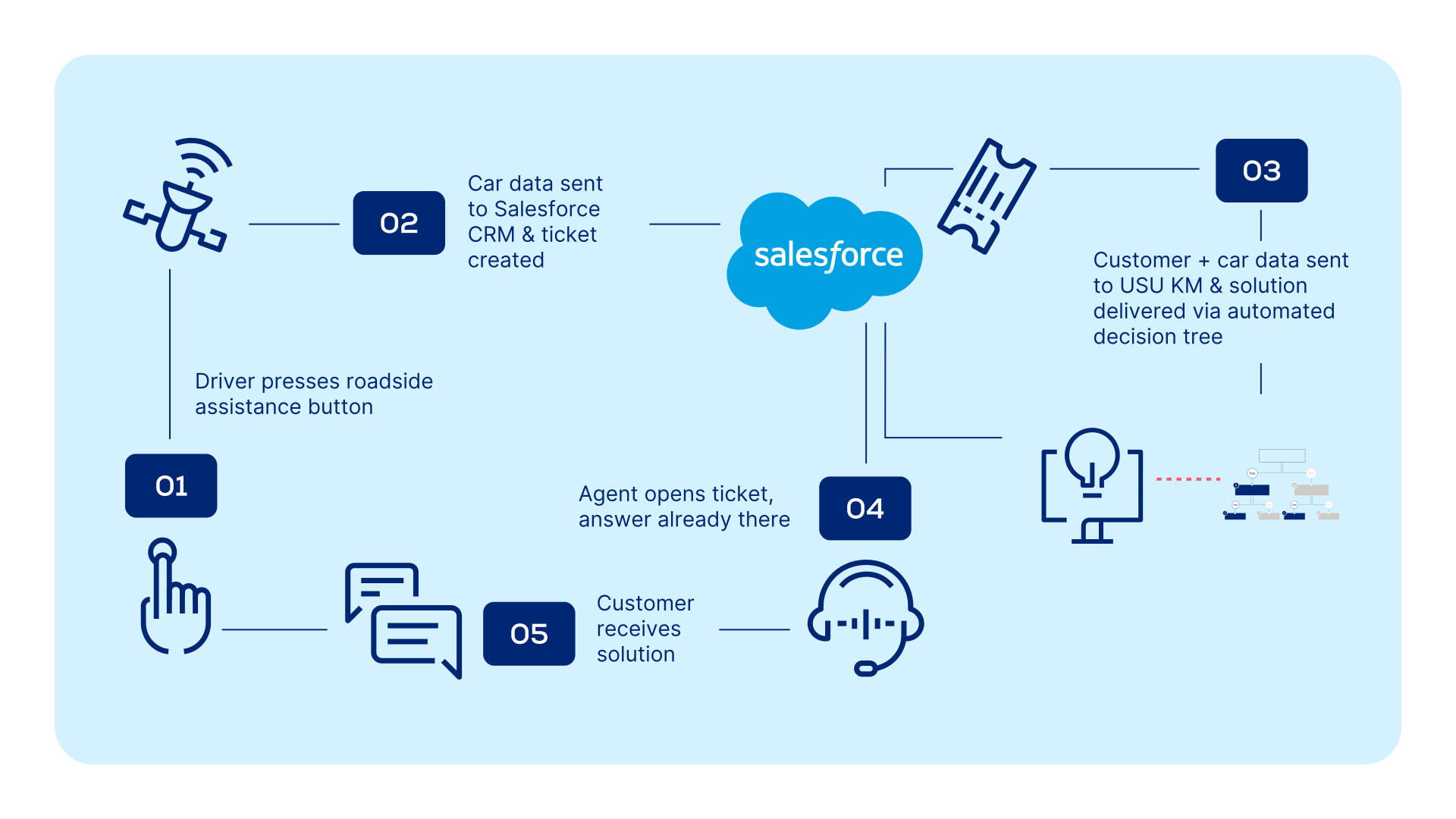
Companies like Volkswagen AG use this integration to make verified knowledge easily accessible within Salesforce and ensure aligned service processes across international teams.

usu-knowledge-management_salesforce-vw-en_1920x1080px

Getting Started

1. Visit the Salesforce AppExchange
2. Login with your credentials
3. Click the "Get it Now" button
4. Install the the new Knowledge Center app (You'll need the necessary rights)
5. Configure user and organization syncing in Salesforce
6. Enjoy your new found powers!

Zendesk Integration

For high-volume ticket handling

Zendesk environments focus on speed and volume. Service agents handle large numbers of repetitive requests where efficiency and consistency are essential.

The integration embeds governed knowledge directly into the Zendesk workspace so information is available within the ticket interface.

  • Reduce ticket handling effort
    When tickets are created or updated, relevant knowledge is suggested based on ticket fields and keywords, minimizing manual searching.


  • Trigger macros and suggested replies
    Responses and Zendesk macros can be triggered directly from structured knowledge guides, enabling fast and standardized replies.


  • Support scalable ticket operations
    Rules connect ticket data with relevant knowledge content, ensuring consistent handling across large ticket volumes.

Intercom Integration

For chat-based support

Intercom is built for live, customer-facing conversations. In chat environments, maintaining response speed and conversational flow is key. Switching between chat and separate knowledge tools interrupts the conversation flow.

The integration embeds verified knowledge directly into the Intercom interface so guidance appears during active conversations.

  • Maintain conversation flow
    Knowledge suggestions are triggered based on keywords and conversation context, supporting accurate responses without interrupting the dialogue.
  • Insert approved responses directly into chat
    Validated answers can be inserted into the reply field without leaving the chat interface.


  • Ensure consistent communication in live interactions
    Rule-based suggestions ensure aligned communication across service-agents handling live interactions.

Slack Integration

For internal collaboration and knowledge sharing

Slack is used for coordination between service agents and experts while resolving questions or coordinating responses. Searching for knowledge in separate tools slows down internal alignment.

The integration connects your centralized knowledge base directly to Slack channels.

  • Find knowledge within team conversations
    Simple commands retrieve relevant knowledge without switching tools.


  • Share content to support decisions
    Articles and guides can be posted directly into discussions.


  • Capture feedback during collaboration
    Feedback shared in Slack can be fed back into the knowledge process for continuous improvement.

Connect additional systems via API

For custom integrations and automation

Many organizations operate custom portals, proprietary systems or specialized applications beyond standard service platforms. In these environments, knowledge must still be accessible and controlled.

The public API provides secure, permission-based access to your centralized knowledge base across your IT landscape.

  • Extend knowledge to custom systems
    Internal tools, customer portals or third-party systems can retrieve verified knowledge directly through controlled API endpoints.


  • Integrate knowledge into automated workflows
    Business processes can automatically retrieve relevant knowledge when specific conditions are met—for example based on ticket data, form submissions or system events.


  • Provide trusted knowledge to AI applications
    Chatbots and AI assistants can access structured, approved knowledge as a trusted foundation.

For organizations with complex architectures, the API makes knowledge a controlled and scalable part of the overall service infrastructure.

Knowledge integration in action

usu-knowledge-management_vw_1000x1000px

Volkswagen

Global roadside support with USU & Salesforce

Get in touch with an expert

Do you have questions about our offering? A quick call can be way more helpful than a long email chain. Talk to one of our experts to explore our products and see them in action.

Screenshot_17-2-2026_14810_www.linkedin.com

Paul Taillier

Sales Development

Knowledge Management

Send us a message

No matter if you like to partner with USU or just have a few questions.