Download whitepaper

The AI Ladder: a strategic roadmap to augmented and autonomous ITAM 

IT asset management (ITAM) is at an inflection point. What traditionally served as a backward-looking inventory of hardware, software, and licenses is reaching its limits in today’s IT environments. Hybrid infrastructure, cloud services—and especially SaaS—have introduced a new level of pace and variability. Usage, cost, and risk shift continuously, and they’re increasingly difficult to manage with manual workflows or periodic audits alone.

At the same time, ITAM teams are under more pressure than ever: accountability and complexity are rising, while budgets and headcount often aren’t keeping up.

That’s where The AI Ladder comes in. Developed in collaboration with the ITAM Forum, this e-book brings together insights from leading ITAM practitioners and industry experts. It introduces a practical maturity model that outlines how ITAM can evolve step by step—from establishing visibility and trust, to generating insight and action, and ultimately reaching bounded autonomy.

The outcome is a more proactive, AI-enabled ITAM function with “always-on” governance: automating repeatable tasks, responding faster, prioritizing more effectively, and enabling ITAM leaders to provide more strategic guidance to the business.

The AI ladder: the maturity model

1st Visibility (Stop Flying Blind)

Near real-time visibility across on-prem, cloud and SaaS: identify assets, normalize data, remove duplicates - the basis for any control system.

2nd Trust (make the data usable)

Data stewardship, governance and validation ensure that AI results are reliable - otherwise errors are scaled automatically.

3rd Insight (spot patterns humans miss)

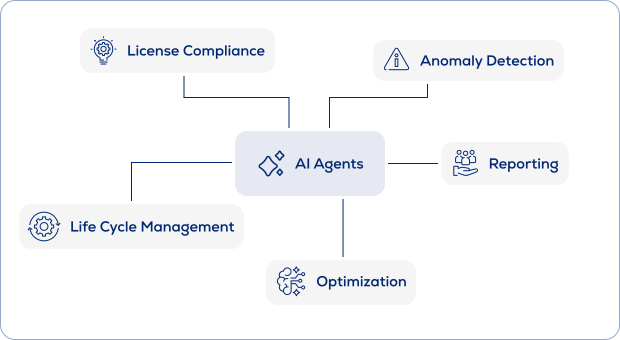
AI recognizes patterns, trends, and risks at machine speed—spotting and predicting issues such as demand shifts, anomalies, license gaps, lifecycle and refresh needs, and contract or renewal risk.

4th Action (close the loop)

"Always-on" governance instead of snapshot reviews: Insights trigger workflows such as reclaiming, tag corrections or low-risk remediation.

5th Autonomy (bounded)

Agents act proactively within clear guardrails: recommend, execute, escalate - with human oversight and defined accountability.

The roadmap in three phases

Foundation - visibility & trust

Discovery and data integrity first: without robust foundations ("garbage in, garbage out"), AI insights are unreliable. Near-real-time discovery makes dynamic SaaS/cloud costs controllable.

Engine - insight & action

AI delivers scalable insights based on trustworthy data: Forecasts, licence risks, optimization. Added value is created when insights trigger workflows - e.g. reclaiming, policy corrections, reconciliation.

Vision - bounded autonomy

Goal: Augmented ITAM with bounded autonomy: AI works proactively within clear guardrails. Humans retain strategy, ethics, vendor management and final accountability.

What you can expect from the e-book

What is the "AI Ladder" in the ITAM context?

A 5-stage maturity model that describes how ITAM matures from visibility via trust and insight to action and finally bounded autonomy.

Why is traditional inventory management no longer enough?

Because hybrid IT and SaaS lead to dynamic, distributed environments. Costs and risks arise continuously ("live") - manual inventories and periodic reviews are too slow.

What does "visibility" mean in concrete terms?

Near real-time transparency across on-prem, cloud and SaaS: Discovery, normalization, deduplication and integrated data sources as a reliable basis.

Why is "Trust" a separate level?

Because AI is only as good as the data. Without governance, stewardship and validation, AI scales data errors ("automated catastrophes") instead of delivering added value.
What insights does AI typically provide in ITAM (level 3)?

Forecasts on usage and demand (e.g. license shortfalls), anomaly detection (risk/compliance), indications of waste (dormant accounts, oversizing) and contract intelligence (clause/risk information).

What is the difference between "Insight" and "Action"?

Insight identifies opportunities/risks. Action closes the loop: insights trigger automated workflows (e.g. reclaiming, tagging corrections, low-risk remediation).

What does "bounded autonomy" mean - and is it safe?

Autonomy means here: Agents act within defined guard rails (policies, thresholds, approvals). Human supervision and final accountability are retained.

Where should you start if the data quality and tool landscape are heterogeneous?

With Visibility + Trust: Improve discovery coverage, clarify responsibilities, define data standards, establish validation. Only then scale insight/action.